

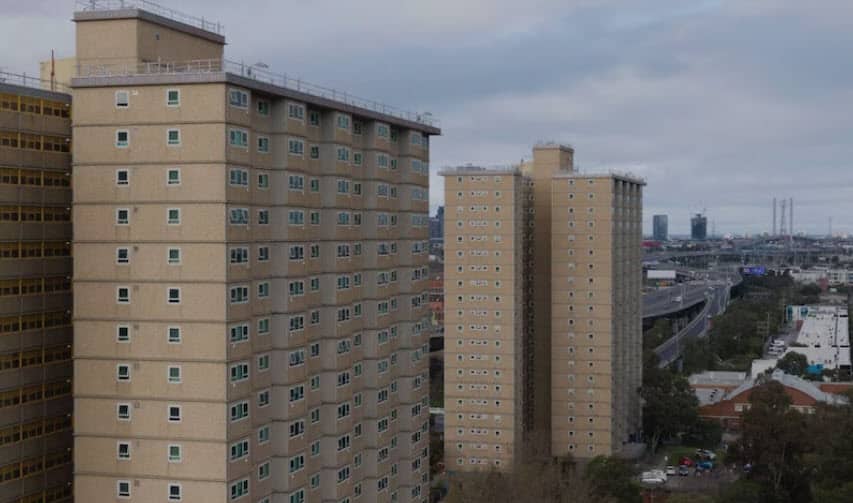
Melbourne’s 44 public housing towers are a critical resource amid Victoria’s housing affordability crisis. This summary proposes refurbishment combined with staged redevelopment as an alternative to the Victorian Government’s demolition plan, supported by expert testimonies, independent reports, and local advocacy. It prioritises feasibility, cost effectiveness, and minimal social disruption, drawing on insights from engineers, architects, councillors, and a community meeting with PhD candidate Ms Vipulananda, while addressing government concerns.
The Case for Refurbishment
Refurbishment focuses on upgrading towers to meet essential standards for accessibility, energy efficiency, and building codes, alongside cosmetic improvements like interior updates and aesthetic enhancements. Independent analyses of sites such as Atherton Gardens in Fitzroy and the Flemington estates suggest significant capital cost savings compared to rebuilding, while reducing embodied carbon emissions and shortening construction timelines.
Engineer Gerry Noonan, who contributed to the towers construction in the 1960s, testified that structural issues like concrete spalling are straightforward to repair, rendering demolition unnecessary and environmentally wasteful. Architect Nigel Bertram notes that retrofitting preserves resources and avoids repeating the community displacements of the mid twentieth century tower builds. Past successes, such as the Atherton Gardens retrofit programme over a decade ago, demonstrate how lifts, laundries, and other amenities can be improved without resident upheaval.
Environmentally, retaining structures saves vast amounts of carbon, equivalent to removing thousands of vehicles from roads. Socially, floor by floor upgrades allow residents to remain nearby, safeguarding established communities. Yarra City Council, which opposed the demolition of 12 towers in Fitzroy, Collingwood, and Richmond in a December 2023 resolution, warns that wholesale demolition risks ethnic and class cleansing, displacing low income and non-white residents from gentrifying areas. Former resident Councillor Meca Ho described relocation misinformation affecting Vietnamese communities, underscoring the human cost. Ms Vipulananda’s research, identifies systemic barriers like council approvals and operational costs as root causes of housing issues, advocating retrofitting to avert homelessness, affordability pressures, racism, and crime linked to displacement. Technical challenges, including earthquake resistance and fire separation, are addressable, with overseas examples of mixed renovations providing precedents. Noonan compares the towers to older Melbourne homes that endure without demolition, and Ms Vipulananda notes that non-compliant stairwells can be upgraded, as seen in other Victorian high rises.
Staged Redevelopment: A Balanced Path Forward
Following refurbishment, phased redevelopment could target compromised towers for selective demolition, incorporating new builds on underutilised spaces like car parks. This ensures housing continuity, as outlined in the OFFICE report for Flemington, which proposes tower retention alongside mid-rise infill. Mayor Stephen Jolly calls for replacing poor quality public housing with improved versions, urging a moratorium on demolition and union boycotts to protect vulnerable residents. Yarra City Councils resolution supports maintaining existing stock and developing additional public housing sites, rejecting privatisation. Ms Vipulananda’s research supports staged redevelopment to drive housing and economic reform by addressing systemic issues. The parliamentary inquiry, concluding hearings in August 2025 with a report due in December, heard these arguments. Resident centric planning prioritises on site relocations, minimising reliance on private rentals. Bertram highlights floor by floor work to avoid mass displacement, while critics accuse the government of opacity, releasing only a fraction of documents amid a class action lawsuit.
Ms Vipulananda’s meeting estimated the towers house around 8800 families, and demolition exacerbates systemic issues. Her PhD at the University of Melbourne stresses addressing root causes for reform, encouraging privileged communities to engage.
Transparency remains a hurdle, with Housing Minister Harriet Shing defending the plan as essential for modern housing, claiming towers are obsolete. Yarra City Council criticises site privatisation and calls for expanded social housing.
Challenges and Broader Implications
Government officials cite deterioration, including pipe erosion and failing sewers, alongside maintenance burdens and non-compliance with fire, earthquake, ventilation, and accessibility standards. Retrofitting, they argue, would be costly over decades without density gains, with only Carlton towers staying fully public. Shing accuses opponents of stalling progress, while privatisation risks rent hikes. Ms Vipulananda challenges these claims, noting private high rises with similar issues are retrofitted, highlighting inconsistent standards.
Logistically, retrofitting may constrain density targets, and coordination is key to avoid delays. Jolly questions double standards, as private apartments receive retrofits despite flaws. Regulatory debates persist on full compliance, though Noonan deems some upgrades excessive. Socially, the class action invokes human rights, and councils highlight community erosion risks. Ms Vipulananda’s research emphasises that demolition could exacerbate social issues like racism and crime due to displacement.
Homelessness exacts heavy economic tolls through health, justice, and service demands, with specialist support costs accumulating over years. Ms Vipulananda notes that displacement could increase homelessness and crime, misattributed to unrelated factors like bail laws. Refurbishment mitigates these by stabilising housing.
Refurbishment spans two to four years per tower, enabling parallel work for stabilisation within five to ten years, fitting the 2023 to 2051 framework. Redevelopment involves longer deconstruction and construction phases, with hybrid options blending approaches for efficiency. Estimates indicate refurbishment savings per dwelling, though uncertainties like inflation and relocation persist due to limited data. Refurbishment extends tower viability for decades, reducing interim homelessness risks exceeding annual per person thresholds.
Conclusion
Refurbishment and staged redevelopment offer a pragmatic future for Victoria’s public housing towers, balancing cost effectiveness, environmental stewardship, and social equity against government renewal priorities. Backed by Yarra City Council’s advocacy and expert input, including Ms Vipulananda’s call to tackle systemic roots, it counters demolitions disruptions. As the inquiry report looms, greater transparency could refine this path, ensuring homes and communities endure while advancing housing reform.